|
Holy Week |
|
|
Provisions for the Journey to Jerusalem
Holy Week, 2026 Brief reflections on the week's Scripture readings
Sunday, March 29: The very large crowd spread their cloaks on the road, while others cut branches from the trees and strewed them on the road. The crowds preceding him and those following kept crying out and saying: "Hosanna to the Son of David; blessed is he who comes in the name of the Lord; hosanna in the highest" (Mt 21:1-11). We sometimes hear the adjective “triumphant” used to describe Jesus’ entry into Jerusalem on Palm Sunday. In his essay, “The Temptation of Palm Sunday,” the late lay theologian, William Stringfellow, writes, “Palm Sunday is not a day of triumph…Palm Sunday is a day of dramatic temptation for Christ. It is a day of profound frustration for the disciples and one on which the apprehensions about Christ on the part of the ruling authorities of Israel and Rome are exposed.” He likens the temptation for human glory that day to the temptations Jesus faced in the desert before he set out on his ministry. “His family and friends and followers, on the one hand, and his enemies, on the other, failed on Palm Sunday to comprehend who Christ really is. All of them were captivated in the temptation with which the power of death confronts Christ. Palm Sunday is no day of triumph; for Christians it is a day of profound humiliation” (from the book Bread and Wine: Readings for Lent and Easter, Second Edition, pp. 151-153). Provision: CHOOSE the crucified Christ. In a world filled with suffering, injustice, and rampant lies, it is easy for me to cling to images of God that give me comfort: a loving mother holding me on her lap, an innocent infant in a manger, the resurrected Christ (even with his wounds); or the empowering breath of the Holy Spirit. Instead, I am called to embrace what Paul says in 1 Cor 2:2: “For I determined to know nothing among you except Jesus Christ, and Him crucified.” In his closing paragraph, Stringfellow tells us, “The counsel of Palm Sunday is that Christians are free to enter into the depths of the world’s existence with nothing to offer the world but their own lives.” St. Augustine tells us, “We are Easter people, and alleluia is our song.” But there is no Easter without Palm Sunday, no alleluia without the misery of Good Friday. As we embark on this Holy Week, let’s consider how we best can join our own lives in sacrifice with Christ.
Monday,
March 30:
Mary
took a liter of costly perfumed oil made from genuine aromatic nard and anointed
the feet of Jesus and dried them with her hair; the house was filled with the
fragrance of the oil. … Jesus said, "Leave her alone. A few things I wonder about in this story: We talked last week about whether Mary was just a bit peeved at her friend, Jesus, when he didn’t rush to Lazarus’ bedside. Might she be anointing him to atone for doubting his devotion and care? After Judas ruins the moment with his complaint about wastefulness, Jesus says to let Mary keep this moment to prepare for his burial. I wonder how Mary reacts to that comment. Does it startle or scare her? Or does she foresee his death? Jesus doesn’t think of this anointing for himself, but as a way to give comfort to those who love him. I’m intrigued with the idea their whole house was filled with the fragrance of the oil. The scent of an expensive oil can last days, even weeks. I wonder if the fragrance remained for them all through the Passover, giving them solace as they mourned and despaired their friend’s death. And did it erase the scent of sorrow with the fragrance of new life as they rejoiced in his resurrection? Provision: PAY ATTENTION to memories that sustain you. During this solemn week of prayer, we, unlike those first disciples, are blessed with the awareness of new life arising to erase the pain and sorrow we experience. When we suffer the Good Fridays and Holy Saturdays in our lives, hold onto the “fragrance” of mercy and consolation God has provided for us. Don’t ignore the difficult emotions we feel but allow the healing balm of God’s love to sustain us. Tuesday, March 31: “Though I thought I had toiled in vain, and for nothing, uselessly, spent my strength, yet my reward is with the LORD, my recompense is with my God” (Is 49:1-6). Does the first half of this verse ring true for you? I talk with many people, discouraged that what they are doing to defend the oppressed is for nothing. Many feel sapped of strength seeing unrestrained lying and wrongdoing continue unabated and with impunity. The events we commemorate this week are all about perseverance in the face of dismay and a reliance on God as our recompense. Provision: “For you are ‘our’ hope, O Lord” (Ps 71). When we feel like giving up is precisely when we recommit to make a difference in the lives of those we touch. Find strength in community (see Thursday’s reflection). Join with other people of good will and hold tight to the sentiment of this quote, often attributed to Margaret Mead, “Never doubt that a small group of thoughtful, committed citizens can change the world: indeed, it’s the only thing that ever has.” What will your community do today to bring about change? Wednesday, April 1: "Lord, in your great love, answer me. The insults of those who blaspheme you fall upon me…insult has broken my heart, and I am weak” (Ps 69). “Oh, do those insults and blasphemy really break my heart or do they just feed the fire of my anger and vengeance? How about when I am the one betraying you by failing to stand up to those who daily, hourly make a mockery of you? It’s easy for me to look with contempt and judgment at those in religious or political power who use your name for their own profit or perversion, but am I as willing to look in the mirror and see my own lack of action? ‘In your great love, Lord, answer me.’ Let me see the truth of my own failings so that I may repent and return to you.” Provision: PAY ATTENTION. Am I…are you…are we doing enough to nonviolently fight against the blasphemy of Christian nationalism? I shared this Dietrick Bonhoeffer quote earlier this year, but it bears repeating: “If I sit next to a madman as he drives a car into a group of innocent bystanders, I can't, as a Christian, simply wait for the catastrophe, then comfort the wounded and bury the dead. I must try to wrestle the steering wheel out of the hands of the driver.” Read his book, The Cost of Discipleship, for inspiration.
A story we have heard so many times that we can gloss over it without giving it the full attention it deserves. So much to take in: Jesus washes Judas’ feet: what does that mean to us? Jesus says he needs to wash our feet before we can be part of him, i.e., learn to care for others by letting Jesus care for us. Dry the feet you have washed, i.e., be caring until the end. Finish the work you have started. Sometimes, that means turning something or someone over to another who can take things further. (This can be hard when we feel like there is nothing else we can do for someone. Remember: “A little help can be a lot of help.” A little love can go a long way.) And, while this encounter of letting Jesus wash my feet is so personal (and great for imaginative prayer), remember it happens in the presence of community. Provision: CHOOSE community. “The Word became flesh so as to wash my tired feet. He touches me precisely where I touch the soil, where earth connects with my body that reaches out to heaven. He kneels and takes my feet in his hands and washes them. Then he looks up at me and, as his eyes and mine meet, he says: Do you understand what I have done for you? If I, your Lord and Master, have washed your feet, you must wash your brothers’ and sisters’ feet.’ As I walk the long, painful journey toward the cross, I must pause on the way to wash my neighbors’ feet. As I kneel before my brothers and sisters, wash their feet, and look into their eyes, I discover that it is because of my brothers and sisters who walk with me that I can make the journey at all” (Henri Nouwen, from “Jesus Gives All,” from Bread and Wine: Readings for Lent and Easter (Second Edition), p. 268).
I mentioned a few weeks ago that my daughter and I went to visit the Legacy Museum in Montgomery, Alabama (https://legacysites.eji.org/about/museum/). There is one wall in the museum that contains large glass jars of dirt taken from sites of lynchings of African Americans. Many of the jars are labeled with name plates. I spent time going along the wall pronouncing the names, remembering them, even though their ancestral names were taken from them. There were several though, that had no name. The unremembered dead. It reminds me of a similar experience several years ago at the US cemetery in Normandy, France: graves marked with the words, “Here rests in honored glory, a comrade in arms known but to God.” I also think of the annual remembrance for homeless people who have died in our country (https://nationalhomeless.org/homeless-persons-memorial-day/); some with names, some unclaimed and unknown. And of course, the horrors of war and violence all over the world that claim the lives of so many innocents, many of them nameless. “How long, O Lord, how long?” Provision: Pray today for the forgotten dead. On this, the day of the Lord’s Passion, spend quiet time in prayer for those who have died alone, without support, without a name. Pray God will call them each by their real name to rest in peace, known and enfolded in God’s embrace. “No greater burden can be borne by an individual than to know that no one cares or understands” (Arthur Stanback). Holy Saturday, April 4: “But this I call to mind; therefore, I have hope: The steadfast love of the LORD never ceases, his mercies never come to an end; they are new every morning; great is your faithfulness”” (Lam 3:1-9,19-24). Fear, bitterness, doubt, grief, anger, despair… these are just some of the emotions the disciples are feeling on this Sabbath, this day of rest. Still faithful to the law, they huddle together in hiding, raw from the events of the past 48 hours. I wonder if any one of them could muster courage or hope from these words from Lamentations. Through their tears, could they remember Jesus’ words to Peter just two days ago: “You do not…you cannot understand now. But have faith. Have hope. I promise you will come to understand. My love will arise anew in the morning.”
• © 2026, Elaine H. Ireland Contact ehireland@gmail.com. |
|


























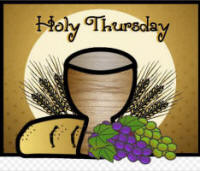 Holy Thursday, April 2:
  Good Friday, April 3:


