|
12th Sunday |
|
|
You can sense the background to today’s selection from Matthew’s Gospel. In this passage, Jesus tells his disciples three times, “Do not be afraid.” The early Church must have been a community that knew fear well. Jesus is preparing his followers for rejection, misunderstanding, and hardship because of their faith. Following him will not always make life easier. So, he tells them, “Fear no one.” He reminds them that they are never abandoned by God.
Most of us know fear in one form or another. We worry about our families, our health, our future, and the divisions in our world and Church. Some of us carry quiet fears that others never see loneliness, failure, grief, or uncertainty about what lies ahead. Fear can shrink our hearts and tempt us to live cautiously, protecting ourselves rather than trusting God. It can also cause disciples to withdraw into closed communities, contrary to Jesus’ command to “Go and make disciples of all nations.” Fear can place limits on that mission.
Jesus assures us that we are held in God’s care and do not need to let fear rule us. Christian courage is not the absence of fear; it is the decision to trust God in the midst of fear. I remember the stories the Sisters used to read to us about the early martyrs. They seemed like superhuman examples of courage. Yet those martyrs were human beings like us. They were not fearless people, but people who believed that God’s love was stronger than whatever threatened them.
The Gospel challenges us to ask what fears keep us from living our faith more openly. Sometimes we remain silent when we should speak a word of kindness or truth. Sometimes we hesitate to forgive, to serve, or to stand with those who are suffering because we fear criticism or discomfort. Jesus calls us to live with confidence, knowing that our lives rest in the hands of a faithful God.
The courage ordinary Christians need today is often quiet and steady rather than dramatic. Most believers will not face prison or martyrdom, but they do face pressures that test their faith every day. It takes courage to remain honest in a dishonest environment, to forgive when resentment feels easier, to defend the dignity of the poor and forgotten, to remain faithful in marriage and family life, and to continue praying when God seems silent.
Christians also need the courage not to be ashamed of their faith. In many places, believers are tempted to keep religion private, avoiding any mention of hope, mercy, justice, or the Gospel for fear of criticism or rejection. Jesus’ words, “Do not be afraid,” are spoken precisely for moments like these. He reminds us that we belong to God and are precious in God’s sight.
Can we trust God where we are? The Gospel says yes—not because life is easy, but because God does not abandon us in the middle of it. God is present in hospitals, prisons, schools, workplaces, broken homes, lonely apartments, and uncertain futures. Trust does not mean that we understand everything. It means that we believe that even when we feel weak, forgotten, or afraid, God still holds us in loving hands.
Many ordinary Christians carry hidden burdens: caring for aging parents, struggling financially, grieving losses, worrying about children, facing illness, or trying to hold on to faith in a divided world. The courage Christ asks of us is to keep walking with him through all of it. Sometimes the greatest act of faith is simply getting up each day and believing that God is still with us.
Jesus points to the sparrows and reminds us that not one of them is forgotten by God. Then he says, “You are worth more than many sparrows.” That is the foundation of Christian courage: not confidence in ourselves, but confidence that we are known, loved, and accompanied by God every step of the way.
In summary, the Gospel for this Sunday tells us not to be afraid. Jesus knows that his disciples will face opposition, misunderstanding, and even rejection. Courage is not something needed only by martyrs and saints of long ago. Ordinary Christians need courage every day: courage to forgive, to speak honestly, to remain faithful in difficult marriages and families, to defend the vulnerable, to resist dishonesty at work, and to continue believing when prayers seem unanswered.
The reading from the prophet Jeremiah (20:10–13) shows us what that courage feels like from the inside. Jeremiah is not fearless. He hears the whispering around him: “Denounce him!” Even his friends are watching for him to fail. He feels isolated and threatened. Many Christians know something of that experience. A young person may feel pressure for living differently from the crowd. A worker may face ridicule for acting with integrity. A believer may feel alone in a culture that often treats faith as irrelevant or naïve.
Yet Jeremiah does not end in despair. He says, “But the Lord is with me, like a mighty champion.” That is the heart of Christian courage. Courage is not pretending that we are strong enough by ourselves. Courage comes from trusting that God stands beside us in our weakness and uncertainty.
Jesus says in the Gospel that even the sparrows are known by God and that “you are worth more than many sparrows.” God’s care is personal and constant. The courage Christians need today grows from this trust: God sees us, knows our struggles, and does not abandon us.
Sometimes courage means taking a public stand for justice or truth. More often, it means quiet perseverance: continuing to love when it is costly, continuing to pray when faith feels dry, and continuing to hope when the world seems cynical. Jeremiah teaches us that faithful people can feel afraid and discouraged and still trust God.
Our world often admires power, success, and self-sufficiency. But Christian courage looks different. It is the courage to remain compassionate in a harsh world, truthful in a dishonest world, hopeful in a despairing world, and faithful in a distracted world.
Today Jeremiah’s words become our prayer as well: “Sing to the Lord, praise the Lord, for he has rescued the life of the poor.” The believer’s courage finally rests not in human strength, but in confidence that God remains faithful through every trial.
Click here for a link to this Sunday’s readings: https://bible.usccb.org/bible/readings/062126.cfm
One of the most frequently cited
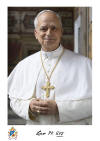
Pope John Paul II
“Do not be afraid. Open wide the doors for Christ.”
But the Lord is with me, like a mighty champion. —Jeremiah 20:11
I find it interesting that today’s readings fall on Father’s Day. The readings speak to not being afraid. From Jeremiah remembering that God is on his side despite the opposition he faces; the psalmist feeling like an outcast because of following the Lord who does not reject the abandoned; to the disciples whom Jesus has instructed to not be afraid. I think of my Dad (and actually, both my parents) who fearlessly lived through the Great Depression and World War II. They were always great examples for me of steady perseverance in the face of the obstacles they faced together during their lives.
Not living in fear is both a mindset and a spiritual strength. As Christians, we can look to the lives of Jesus, Mary, Joseph, and the disciples, to model the ways to live or become fearless. The challenges we face today often bring fear of the unknown and how we handle them is a testament to those who have inspired and inspirited us. We, in turn, become a testament for others. I came across the following sweet poem, anonymous in authorship, that I have adapted for its timeless message.
Our Lord and Lady keep a garden.
They turn us to the sunshine,
And when the winds and rain come,
Their constant example The next time life becomes fear-filled, fear not.
We are our Lord and Lady’s garden,
Barbara Molinari Quinby, MPS, Director Office of Human Life, Dignity, and Justice Ministries Holy Name of Jesus Cathedral, Raleigh, NC
Mini-reflections on the Sunday scripture readings designed for persons on the run. “Faith Book” is also brief enough to be posted in the Sunday parish bulletins people take home. From today’s Gospel reading:
So do not
be afraid; you are worth more than many sparrows.
Reflection:
Jesus knows that fear can keep us silent about our faith. He reassures us that we are precious in God's eyes – worth far more than many sparrows. Because we are loved and valued by God, we can face life's challenges with confidence. When we acknowledge Christ in our words and actions, we witness to the One who never stops claiming us as his own.
So, we ask ourselves:
· What fears keep me from openly living or speaking about my faith? · Do I truly believe that I am precious and loved by God, even in my weaknesses? · How can I acknowledge Christ today through my actions, words, or choices?
POSTCARDS TO DEATH-ROW INMATES
“I offer my support to those who advocate for the abolition of the death penalty in the United States of America and around the world.” ----Pope Leo XIV
Inmates on death row are the most forgotten people in the prison system. Each week I am posting in this space several inmates’ names and locations. I invite you to write a postcard to one or more of them to let them know that: we have not forgotten them; are praying for them and their families; or whatever personal encouragement you might like to give them.
If the inmate responds, you might consider becoming pen pals.
Please write to:
· Danny Frogg #0137368 (On death row since 3/27/1998) · Timmy Grooms #0158506 (4/24/1998) · Johnny Hyde #0542024 (7/23/1998)
Central Prison PO Box 247, Phoenix MD 21131 (While the prison is in Raleigh mail for inmates is processed at this address)
For more information on the Catholic position on the death penalty go to the Catholic Mobilizing Network: https://catholicsmobilizing.org/
“First Impressions” is a service to preachers and those wishing to prepare for Sunday worship. It is sponsored by the Dominican Friars. If you would like “First Impressions” sent weekly to a friend, CLICK HERE.
If you would like to support this ministry, please send tax deductible contributions to:
Fr. Jude Siciliano, OP St. Albert Priory 3150 Vince Hagan Drive Irving, Texas 75062-4736
Make checks payable to: Dominican Friars.
Or go to our webpage to make a secure online donation: https://www.PreacherExchange.com/donations.htm
FREE EMAILS:
We have two English email lists available: a. A preacher's early reflections on the upcoming Sunday's readings and liturgy, always at least one week ahead of the Liturgical Calendar. “A tool to help Preachers prepare for their next trip to the Ambo.” Available in Spanish & English and authored by Fr. Jude Siciliano, OP. b. Click Here to Sign Up. 2. “VOLUME II” These reflections follow the Liturgical Calendar and appear here about mid-week each week. They are written by various guest authors. If you would like to submit a reflection of your own, then Click Here to send it as a “Request to Post” to the Webmaster. Deadline is Monday of each week for the upcoming Sunday.
OUR WEBSITE:
https://www.PreacherExchange.com - Where you will find Preachers Exchange, which includes “First Impressions,” and “Volume 2” as well as articles, book reviews, daily homilies and other material pertinent to preaching and Scripture reflection.
FOR INFORMATION OF “ANY KIND” OR TO MAKE A SUGGESTION: Click Here
(Always includes the 6 latest reflections with the newest first.)
• |
|




















 Dear Preachers: